
Buying vs. Leasing Beverage Equipment: Which Makes More Financial Sense?
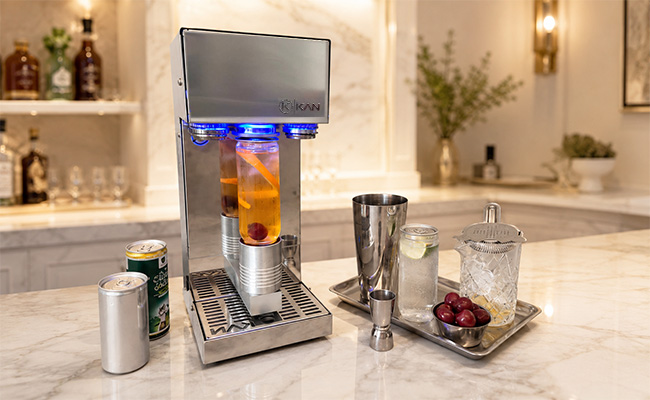
Buying beverage equipment is usually more economical over the long term, while leasing can be the better choice when protecting cash flow, testing demand, or starting with uncertain production volumes. The right decision depends on how often you will use the equipment, how quickly you expect sales to grow, and whether the upfront investment would be better used elsewhere in the business.
For beverage startups, the question is not simply “Can I afford the machine?” It is:
“Will owning this equipment generate enough value to justify the capital I put into it?”
Eazy Canning’s iKAN can seamer provides a useful example. The current purchase price is €3,280, while leasing starts at €100 per month over a 36-month period, with rates varying by business type and location.
Buying vs. Leasing Beverage Equipment: What Is the Difference?
Buying means paying for the equipment upfront and owning it as a business asset.
Leasing spreads the cost into regular payments, allowing you to use the equipment without committing the full purchase price immediately.
For a small beverage producer, both approaches can make sense.
| Buying | Leasing |
| Higher upfront investment | Lower initial cash requirement |
| Equipment becomes your asset | Predictable monthly payments |
| No lease payments after purchase | Preserves working capital |
| Potential resale value | Easier to manage early cash flow |
| Often better for long-term use | Useful when demand is uncertain |
The important point is that the cheapest option on paper is not necessarily the best option for your business.
How Much Does Beverage Equipment Cost?
Equipment costs vary significantly depending on capacity and automation.
Eazy Canning focuses on compact equipment for small and medium beverage producers, rather than large industrial canning lines. Its iKAN can seamer is currently listed at €3,280 for purchase, with leasing available from €100 per month over 36 months.
The FENIX can filler is another component of the system. It is a compact, manual reverse-pressure filling head designed for applications including microbreweries, cold brew and nitro coffee, kombucha, sparkling beverages, and beverage startups.
This distinction matters economically: a startup does not necessarily have to invest in a large automated canning line to begin producing small batches.
Is Buying Beverage Equipment Worth It?
Buying can be worth it if you expect to use the equipment consistently for several years.
Once the equipment has been paid for, your ongoing equipment cost is no longer a monthly lease payment. You also own an asset that may retain some resale value.
For example, the iKAN purchase price is €3,280. If you use it for five years, the simple purchase cost averages:
€3,280 ÷ 5 = €656 per year
Or approximately:
€55 per month
This is only a simple way of looking at the investment. It does not include maintenance, financing, depreciation, labor, consumables, or the potential resale value of the machine.
But it demonstrates an important principle:
The longer and more consistently you use equipment, the more attractive ownership can become.
When Does Buying Make More Sense?
Buying is generally more attractive when:
You Have Predictable Production
If you already have regular customers and know that the machine will be used frequently, ownership can provide better long-term economics.
You Plan to Keep the Equipment for Years
A machine used for several years can spread its initial cost across many production batches.
You Have Enough Working Capital
Buying should not leave you without enough money for ingredients, cans, marketing, staffing, rent, or other operating expenses.
You Want Maximum Control
Ownership means you are not tied to a leasing agreement and can continue using the equipment as long as it meets your production needs.
You May Resell the Equipment Later
A purchased machine is a business asset. Depending on its condition, age, and market demand, it may have resale value.
When Does Leasing Make More Sense?
Leasing can be particularly useful for startups because cash flow is often more important than ownership during the early stages.
You Want to Preserve Cash
Instead of spending €3,280 upfront on an iKAN, for example, a business can spread the cost through leasing. Eazy Canning currently lists leasing from €100 per month over 36 months, subject to the applicable terms.
The money you do not spend upfront can remain available for:
- Ingredients
- Cans and lids
- Branding
- Marketing
- Staff
- Distribution
- Product development
- Working capital
Your Sales Are Still Uncertain
If you are still testing a beverage concept, committing a large amount of capital to equipment may create unnecessary risk.
Eazy Canning specifically positions its compact systems for product testing, samples, limited production runs, and early market development.
You Expect Production to Grow
Your equipment needs at 5,000 cans per year may be very different from your needs at 100,000 cans per year.
Leasing can give you more flexibility while you determine how quickly the business will scale.
The Economics: Buy vs. Lease
Consider a simplified example using the current iKAN figures:
Purchase: €3,280
Lease: €100/month
36 months of leasing: €3,600
On the face of it, purchasing costs less than paying €100 per month for 36 months:
€3,600 − €3,280 = €320
However, this does not mean buying is automatically the better financial decision.
Why?
Because €3,280 paid today has a different financial impact from €100 paid each month.
If that €3,280 would otherwise be used to generate sales, buy inventory, fund marketing, or maintain working capital, leasing may create more value for the startup despite the higher nominal equipment cost.
This is why beverage equipment should be evaluated using total cost of ownership and cash flow, not purchase price alone.
Calculate the Cost Per Can
One of the most useful ways to determine whether equipment is worth buying is to calculate its cost per can.
For example, suppose you purchase an iKAN for €3,280 and eventually use it to seam 50,000 cans.
The equipment purchase cost per can would be:
€3,280 ÷ 50,000 = €0.0656 per can
That’s about €0.066 per can before considering other costs.
At 100,000 cans:
€3,280 ÷ 100,000 = €0.0328 per can
That’s about €0.033 per can.
This illustrates why equipment becomes more economically attractive as utilization increases.
The machine itself does not necessarily become cheaper. Your fixed equipment cost is simply spread across more units.
Buying vs. Outsourcing Canning
There is another financial comparison beverage startups should make:
Buy equipment vs. lease equipment vs. outsource production.
Outsourcing canning can be convenient, but the per-can cost can become significant, particularly for frequent small batches. Eazy Canning notes that co-packing can cost roughly €0.30–€0.60 per can, depending on volume and circumstances.
For a business producing 10,000 cans:
- At €0.30/can = €3,000
- At €0.60/can = €6,000
Those numbers do not automatically mean buying equipment is better. You still need to account for labor, ingredients, cans, utilities, cleaning, quality control, maintenance, and other production costs.
But if you repeatedly produce small batches, the economics of bringing packaging in-house can become increasingly attractive.
What About the FENIX Can Filler?
The same economic thinking applies to filling equipment.
The FENIX is a manual reverse-pressure filling head designed for smaller production environments. It can operate at pressures of up to 4 bar, with approximately 3–4 cans per minute per head and up to 100–150 cans per hour in a dual-head configuration.
For a startup, its value is not simply its filling speed.
The bigger advantage is access to in-house filling without immediately moving to a large automated production line.
That can allow a producer to:
- Run smaller batches
- Test new flavors
- Produce samples
- Adjust production to demand
- Avoid committing to large minimum runs
- Build sales before investing in higher-capacity automation
A Simple Break-Even Question
Before buying or leasing, ask:
How many cans will I realistically produce during the period I plan to use this equipment?
Then calculate:
Equipment cost ÷ expected number of cans = equipment cost per can
You can then compare that figure with:
- Co-packing costs
- Your labor cost
- Expected gross margin
- Equipment maintenance
- Consumables
- Financing or lease costs
- Storage and facility costs
This gives you a much more realistic picture of whether bringing canning in-house makes financial sense.
Don’t Forget Total Cost of Ownership
The purchase price is only one part of the calculation.
Your real equipment cost may include:
- Purchase or lease payments
- Installation and setup
- Shipping
- Training
- Maintenance
- Spare parts
- Cleaning
- Consumables
- Labor
- Downtime
- Utilities
Eazy Canning recommends considering total cost of ownership when evaluating filling equipment rather than looking only at the initial price.
A cheaper machine that creates significant downtime may ultimately cost more than a higher-quality machine that runs reliably.
Buy or Lease: A Practical Decision Guide
Buying is probably the better choice if:
- You have stable demand
- You expect to use the machine for several years
- You have sufficient cash reserves
- You want to own the equipment
- You expect high utilization
- You want to avoid ongoing lease payments
Leasing is probably the better choice if:
- You are an early-stage startup
- Cash flow is a priority
- Production volumes are uncertain
- You are testing the market
- You want predictable monthly expenses
- You want to avoid a large upfront investment
What About a Beverage Startup Just Getting Started?
For a startup without established demand, leasing can reduce the financial risk of entering in-house canning.
You can use the equipment to test your product, create professional samples, run limited batches, and collect real sales data before committing additional capital to production.
Once demand becomes predictable, purchasing equipment—or moving to a more automated solution—may make more economic sense.
This gradual approach is consistent with Eazy Canning’s startup model: start with compact equipment, build demand, and increase production capacity when the numbers justify it.
So, Is Beverage Equipment Actually Worth Buying?
Yes! If you will use it enough to justify the investment.
The question is not whether a can seamer or filler is expensive. The question is whether the equipment will:
- Reduce your packaging cost
- Increase your production flexibility
- Allow smaller production runs
- Reduce dependence on co-packers
- Help you respond to demand
- Generate enough additional margin to recover the investment
For a small producer with consistent demand, owning compact equipment can become a valuable long-term asset.
For a startup still proving its product-market fit, leasing may be the safer financial decision because it preserves cash while allowing the business to test in-house production.
Final Takeaway
Buy beverage equipment when utilization is high, demand is predictable, and you have enough capital to make the investment without restricting growth. Lease when cash flow matters more than ownership and you are still uncertain about production volume.
For small beverage businesses, compact equipment can make this decision more manageable. Eazy Canning’s iKAN can seamer is currently available for purchase at €3,280 or through leasing starting at €100/month over 36 months, while the FENIX provides a compact counter-pressure filling solution for small and medium production.
The smartest approach is to calculate your expected cans per month, cost per can, equipment utilization, cash position, and expected payback period before choosing.
In other words:
Don’t ask only, “Can I afford the equipment?” Ask, “How many cans will this equipment help me produce, and how quickly will it pay for itself?”
