
Best Canning Equipment for Coffee Shops
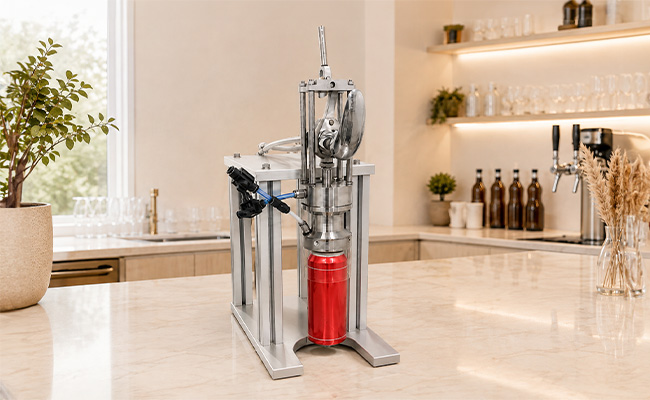
For most coffee shops producing canned cold brew, nitro coffee, or other ready-to-drink beverages, the best canning setup is a compact filler paired with a professional can seamer. The right equipment depends on your production volume, beverage type, can size, filling method, available space, budget, labor, sanitation requirements, and plans for future growth.
A coffee shop does not necessarily need an industrial canning line. Compact tabletop equipment can provide a practical way to start with small batches, test demand, and scale production as sales grow. Eazy Canning specifically designs its FENIX can filler and iKAN can seamer for coffee shops, roasteries, and other small beverage producers.
What Canning Equipment Does a Coffee Shop Actually Need?
For a basic in-house canning operation, there are two core machines:
- Can filler – fills the can with the beverage while controlling the filling process.
- Can seamer – closes the filled can and creates the final seam.
For coffee shops, the choice between different machines should start with the beverage and expected production volume rather than simply choosing the fastest equipment available.
Eazy Canning’s FENIX + iKAN combination is designed around this small-scale model: FENIX handles filling, while iKAN handles sealing.
1. Start With Your Production Volume
The first buyer question should be:
How many cans do you actually need to produce per day or per week?
A café producing a few hundred cans per week has very different equipment requirements from a coffee brand producing thousands of cans every day.
For small production, manual or semi-manual equipment can be more economical than investing in an automated line that spends most of its time idle.
Eazy Canning’s capacity
The FENIX filling head can fill approximately 3–4 cans per minute per head, with a dual-head configuration reaching approximately 100–150 cans per hour, depending on workflow.
The iKAN can seamer can process up to 10 cans per minute.
This makes the system more appropriate for small and medium production than for high-volume industrial manufacturing.
Buyer rule
If your current production is relatively low, prioritize:
- Low equipment cost
- Compact size
- Simple operation
- Easy cleaning
- Flexibility
Don’t pay for industrial capacity you will not use.
2. Consider the Beverage Type
The beverage you are packaging determines what kind of filling technology you need.
Coffee shops commonly consider canning for:
- Cold brew coffee
- Nitro coffee
- Iced coffee
- Sparkling coffee
- Specialty ready-to-drink beverages
Cold brew and nitro coffee require particular attention to oxygen exposure, foaming, and gas retention. Coffee is sensitive to oxidation, while nitrogen-infused beverages need an appropriate filling process to retain their desired characteristics.
Why the filling method matters
A simple open-air filling process may not be appropriate when product quality depends on controlling oxygen or retaining dissolved gas.
The FENIX uses reverse-pressure/counter-pressure filling, operating at up to 4 bar. The process is designed to reduce foaming and oxygen pickup during filling.
For coffee shops producing cold brew or nitro coffee, this is one of the most important equipment-selection considerations.
3. Check Can Size Compatibility
Your preferred can format should be decided before purchasing equipment.
Coffee shops may want:
- Small single-serve cans
- Standard RTD coffee cans
- Larger multi-serve formats
The FENIX currently accommodates standard 202-diameter cans, with custom sizes available upon request.
The iKAN supports cans from approximately 200 ml to 1,000 ml and can accommodate can diameters from 200–209 mm.
Before buying, confirm both the can volume and can diameter, because a machine’s ability to handle one can format does not automatically mean it will handle every can on the market.
4. Choose the Right Filling Method
For coffee shops, filling method can have a direct effect on product quality.
Counter-pressure filling works by pressurizing the can before the beverage enters it. This helps reduce excessive foaming and limits oxygen exposure. For carbonated or nitrogenated beverages, controlling pressure can also help retain the desired gas characteristics.
The FENIX is built specifically around this principle.
Its clamping system locks inside the can neck with a lever movement, creating a tight connection during filling. The unit is made entirely from food-grade stainless steel and is compatible with Clean-In-Place systems.
For a café producing sensitive coffee beverages, these features can be more important than simply maximizing cans per minute.
5. Measure Your Available Space
Space is one of the biggest constraints for coffee shops.
A traditional industrial canning line can require substantial floor space, but a café-focused system can be much smaller.
The iKAN measures approximately 44 × 18 × 35 cm and weighs around 18 kg, making it suitable for a standard preparation table and allowing it to be repositioned when necessary.
The FENIX itself weighs approximately 4.3 kg.
This compact footprint means a coffee shop can potentially build a canning station in:
- A back room
- A commercial kitchen
- A preparation area
- A dedicated counter
- A small production workspace
Eazy Canning’s own guidance emphasizes that coffee shops do not necessarily need a factory-sized facility to begin canning.
6. Set a Realistic Budget
The cheapest machine is not necessarily the best machine.
Instead, calculate the total cost of getting one finished can ready for sale.
Consider:
- Filler
- Seamer
- Cans and lids
- Cleaning equipment
- CO₂ or nitrogen requirements
- Labels
- Date coding
- Labor
- Maintenance
- Storage
- Waste
- Packaging materials
For a small café, compact manual equipment can make the initial investment considerably more manageable than a fully automated canning line.
The financial question should therefore be:
How much will the equipment cost compared with the margin and additional revenue generated by canned beverages?
If canned cold brew allows a café to sell through retail, takeaway, wholesale, delivery, or other channels, the equipment can support revenue beyond the physical café counter.
7. Consider Labor and Ease of Use
Coffee shops cannot always dedicate a full-time packaging operator to a canning machine.
Equipment should therefore be easy for staff to learn and integrate into the existing workflow.
The iKAN is designed as a manual tabletop seamer with simple operation, while the FENIX uses a manual clamping and filling system.
The important question is not just:
“How fast is the machine?”
It is:
“How many finished cans can my team realistically produce per hour without disrupting normal café operations?”
A slower machine that is easy to clean, operate, and maintain may be more useful to a small café than a high-speed system that requires dedicated staff.
8. Don’t Compromise on Sanitation
Sanitation is a critical part of beverage canning.
Coffee beverages can be sensitive to contamination and oxidation, so the filling process needs to be integrated with a suitable cleaning and sanitation routine.
The FENIX is CIP-compatible, allowing it to be cleaned in place and reducing the need for extensive disassembly. Its food-grade stainless-steel construction is also designed for hygienic beverage production.
Your overall coffee canning setup should also include an appropriate process for:
- Cleaning beverage-contact surfaces
- Sanitizing equipment
- Managing hoses and connections
- Cleaning cans and lids as required
- Preventing cross-contamination
- Checking finished cans
Equipment alone does not guarantee shelf life or food safety. Your entire production process needs to be appropriate for the specific beverage and applicable regulations.
9. Think About Scalability Before You Buy
A common mistake is buying equipment only for today’s production volume.
A better question is:
What will production look like if this product succeeds?
For example, a coffee shop might begin with:
Small batches → Test demand → Increase production → Add filling capacity → Move toward greater automation
The FENIX can be used as a single filling head and configured with a dual-head setup for higher throughput. The iKAN can process up to approximately 10 cans per minute.
This gives a small producer room to increase output without immediately committing to a large industrial system.
Where Does Eazy Canning Fit?
Eazy Canning is particularly relevant when a coffee shop wants to move into small- or medium-scale in-house canning without building a factory-style production line.
Its two core machines address the two most important packaging stages:
FENIX — Can Filler
The FENIX is a manual reverse-pressure filling head designed for controlled filling. It operates at up to 4 bar, fills approximately 3–4 cans per minute per head, and can reach approximately 100–150 cans per hour in a dual-head configuration. It is made from food-grade stainless steel and is CIP-compatible.
Best fit: coffee shops producing cold brew, nitro coffee, and other still, carbonated, or nitrogenated beverages where controlled filling is important.
iKAN — Can Seamer
The iKAN is a compact tabletop can seamer designed to create professional seams after filling. It supports approximately 200 ml–1 L cans, handles 200–209 mm can diameters, and can seam up to 10 cans per minute.
Best fit: coffee shops that need a compact, professional sealing solution for takeaway, retail, or wholesale canned beverages.
Together: FENIX + iKAN
The workflow is straightforward:
Prepare beverage → Fill with FENIX → Place lid → Seam with iKAN → Quality check → Label/code → Store
Eazy Canning specifically recommends pairing the two machines to create a complete compact canning solution.
Who Should Buy This Type of Canning Equipment?
Eazy Canning’s setup is particularly well suited to coffee businesses that:
- Produce cold brew or nitro coffee
- Want to create ready-to-drink products
- Need small-batch production
- Have limited production space
- Want to test retail demand
- Want to sell beyond the café
- Prefer in-house control
- Need equipment that can scale with demand
It may be less appropriate for a business that already requires very high-volume automated production and has the budget and facility for a full industrial canning line.
Best Canning Equipment for a Coffee Shop: Quick Buyer Guide
| What to evaluate | What to look for |
| Production volume | Equipment capacity that matches actual demand |
| Beverage type | Counter-pressure capability for sensitive, carbonated, or nitrogenated drinks |
| Can size | Compatibility with your chosen can diameter and volume |
| Filling method | Controlled filling with low foaming and oxygen exposure |
| Available space | Compact tabletop equipment for café environments |
| Budget | Total cost of ownership, not just purchase price |
| Labor | Simple operation and manageable batch workflow |
| Sanitation | Food-grade construction and easy cleaning |
| Scalability | Ability to increase output as demand grows |
Final Takeaway
The best canning equipment for a coffee shop is not necessarily the fastest machine. It is the system that matches your production volume, beverage, can format, workspace, budget, labor capacity, sanitation requirements, and growth plans.
For many cafés producing canned cold brew, nitro coffee, or specialty RTD beverages, a compact counter-pressure filler and professional can seamer offer a practical starting point.
Eazy Canning’s FENIX + iKAN system fits this use case particularly well: FENIX provides controlled reverse-pressure filling, while iKAN provides compact professional can seaming. Both are designed with small and medium producers in mind rather than requiring a large industrial production line.
The smartest buying decision is therefore not “Which machine is the most powerful?”
It is: “Which machine can handle the production I have today while giving me enough flexibility to grow tomorrow?”
