
How Many Cans Should a Beverage Startup Produce for Its First Test Batch?
aunching a new beverage comes with a difficult question: How many cans should you produce for your first batch?
Produce too little, and you may not collect enough feedback or reach enough customers. Produce too much, and you could end up with excess inventory before you know whether the market wants your product.
For most beverage startups, the best approach is to start with a small, controlled pilot batch, measure the results, and increase production as demand becomes clearer.
There is no universal number of cans that works for every business. The right batch size depends on what you are testing, who you are testing with, and how quickly you can produce another batch.
How Many Cans Should You Produce?
As a general planning guide:
| Purpose | Example batch size |
| Internal product testing | 20–50 cans |
| Samples for buyers or partners | 25–100 cans |
| Event or market test | 50–200 cans |
| Local customer test | 100–300 cans |
| Small retail pilot | 200–500 cans |
| Larger market test | 500–1,000+ cans |
These are starting points rather than fixed requirements. Your actual quantity should take into account your beverage, shelf life, sales channels, production process, and available budget.
The key principle is simple:
Produce enough to learn, but not so much that you create unnecessary inventory.
Start With What You Want to Test
Your first batch should be based on a specific business objective.
Are you testing:
- The beverage formula?
- Customer response?
- Packaging?
- Pricing?
- A new flavor?
- Retail demand?
- Production efficiency?
For example, if you are testing three different flavors, producing 100 cans of each may be less useful than producing smaller quantities of all three and comparing their performance.
If you are testing a product in five retail locations, calculate your batch around the number of cans each location realistically needs.
Instead of asking:
“How many cans can we produce?”
ask:
“How many cans do we need to answer our first business question?”
Samples vs. Commercial Pilot Batches
It is important to distinguish between a sample batch and a commercial pilot.
Sample batch
A sample batch is primarily used for:
- Product tasting
- Investor presentations
- Retailer meetings
- Distributor samples
- Customer feedback
- Events and demonstrations
You may only need a few dozen cans.
Commercial pilot
A commercial pilot is designed to test the product under real selling conditions.
You might distribute the cans through:
- Retail stores
- Cafés
- Restaurants
- Bars
- Local markets
- Events
- Online sales
A commercial pilot needs more units because you are testing not just whether people like the beverage, but whether they will actually buy it.
How to Calculate Your First Batch
A simple way to plan your first production run is:
Expected sales + samples + testing + reserve = target batch size
For example, imagine you want to test your beverage in four retail locations.
You estimate:
- 40 cans per store = 160 cans
- 20 cans for samples
- 10 cans for internal testing
- 10 cans as reserve
Your target batch would be:
200 cans
This approach is more useful than choosing an arbitrary number such as 500 or 1,000 cans.
Avoid Excess Inventory
Every can represents an investment in:
- Ingredients
- Cans and lids
- Labels
- Labor
- Packaging
- Storage
- Transportation
If your beverage does not sell as quickly as expected, that money remains tied up in inventory.
This is especially important for startups because early production often involves uncertainty around:
- Customer demand
- Pricing
- Product-market fit
- Flavor preferences
- Retail performance
- Sales velocity
A smaller pilot lets you collect real market data before committing more capital.
When Should You Increase Production?
Your first batch should not necessarily be your smallest possible batch forever.
The goal is to increase production as evidence of demand grows.
Consider increasing your batch size when:
- Customers are buying repeatedly.
- Retailers are placing reorders.
- Sales are consistent across multiple batches.
- You understand your production costs.
- Your production process is reliable.
- You can maintain quality at higher volumes.
- You have enough storage and distribution capacity.
A useful progression can be:
Small test → Market feedback → Repeat batch → Consistent sales → Larger production
This allows the business to grow without making a large production commitment too early.
How Compact Canning Equipment Helps
For startups, production flexibility can be just as important as production speed.
If every new batch requires a large minimum order from a co-packer, you may have to produce more cans than you actually need.
Compact in-house equipment can provide another option.
With a smaller canning setup, a beverage startup can produce manageable batches, test them in the market, and adjust future production based on actual demand.
Eazy Canning’s equipment is designed for small and medium beverage producers, making it relevant to startups that want to develop a flexible in-house canning workflow.
FENIX Filling System
Eazy Canning’s FENIX is a manual reverse-pressure filling system designed for beverage filling. It supports counter-pressure filling up to 4 bar and can fill approximately 3–4 cans per minute per filling head. A dual-head configuration can reach approximately 100–150 cans per hour, depending on the workflow.
This makes it suitable for businesses that need controlled filling without immediately investing in a large industrial filling system.
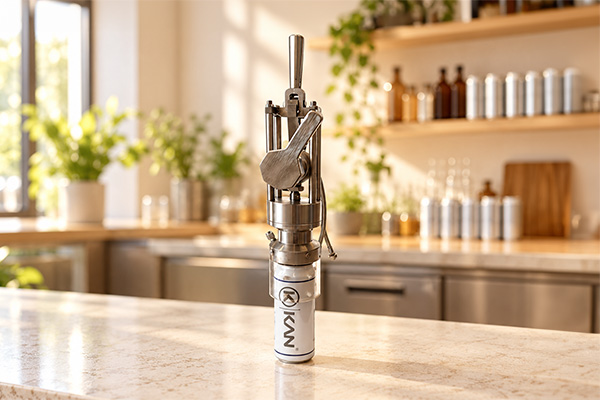
iKAN Can Seamer
The iKAN is a compact tabletop can seamer for small and medium production. Eazy Canning lists a speed of up to approximately 10 cans per minute and can sizes from approximately 200 ml to 1,000 ml, depending on configuration.
Together, FENIX and iKAN can form a compact filling and seaming workflow:
FENIX → Fill
iKAN → Seam
This can be particularly useful for startups producing pilot batches, limited releases, samples, and small commercial runs.
Why Small-Batch Production Can Be a Smart Strategy
Starting small does not mean thinking small.
It means using early production to learn before scaling.
A pilot batch can help you discover:
- Which flavor customers prefer
- Which can size works best
- Whether your price is competitive
- Which sales channels perform best
- How quickly inventory moves
- How much product you can realistically produce
- Where your production process needs improvement
Once you have that information, you can make a better decision about your next batch.
Instead of guessing how much demand you will have, you can use actual sales data to guide production.
For some businesses, 50 cans may be enough. For others, 200, 500, or 1,000 cans may make sense.
For startups that want greater flexibility over small and medium production runs, compact equipment such as Eazy Canning’s FENIX filling system and iKAN can seamer can make it easier to move from product testing to repeatable in-house production.
Start with what you can learn from. Scale when the market gives you a reason to.

Leave a Reply