
The Growth of Ready-to-Drink Beverages: What It Means for Beverage Brands
Ready-to-drink (RTD) beverages are growing because consumers increasingly want products that combine convenience, portability, familiar consumption occasions, and added value such as functional ingredients.
RTD coffee and tea, functional drinks, energy drinks, ready-to-drink cocktails, and other packaged beverages allow consumers to purchase a finished product that requires little or no preparation.
RTD now covers a broad range of products, including cold brew coffee, iced tea, functional drinks, energy drinks, soft drinks, kombucha, mocktails, cocktails, and other specialty beverages.
This creates demand not only for new beverage concepts, but also for flexible packaging and canning equipment that allows smaller producers to test and commercialize products without immediately investing in a large industrial production line.
What Is an RTD Beverage?
A ready-to-drink beverage is a packaged drink that is prepared for consumption without significant additional preparation by the consumer.
Common RTD categories include:
- Ready-to-drink coffee
- Ready-to-drink tea
- Energy drinks
- Sports and functional beverages
- Soft drinks
- Kombucha
- Flavored and sparkling beverages
- Ready-to-drink cocktails
- Ready-to-drink mocktails
- Specialty and premium beverages
Market definitions vary between research companies and individual categories. For example, Statista defines its RTD coffee and tea segment as packaged coffee and tea beverages in liquid form that are ready for consumption.
This distinction matters because RTD is not one single product category. It is a packaging and consumption model that spans multiple beverage categories.
Why Are Ready-to-Drink Beverages Growing?
Several consumer and market trends are contributing to the development of RTD beverages.
The most important include:
- Convenience
- Portability
- Changing consumption occasions
- Demand for functional benefits
- Premiumization
- Product innovation
- Expansion beyond traditional beverage channels
These trends do not affect every market or RTD category equally, but together they help explain why ready-to-drink formats continue to attract beverage companies and consumers.
Convenience Is a Major Driver of RTD Beverages
One of the simplest reasons consumers choose RTD products is convenience.
An RTD beverage removes several steps from the consumption process.
Instead of:
Buy ingredients → prepare → mix → serve → clean
the consumer can simply:
Open → drink
This is particularly relevant for consumers who are:
- commuting
- working
- traveling
- exercising
- shopping
- attending events
- studying
- spending time outdoors
Statista’s market analysis of RTD coffee and tea identifies convenience and on-the-go consumption as important factors behind demand, particularly as consumers look for quick alternatives to beverages that require preparation.
For beverage brands, convenience therefore becomes part of the product proposition rather than simply a packaging benefit.
Portability Changes Where Beverages Are Consumed
Traditional beverages are often connected to a specific place.
Coffee may be consumed in a café.
A cocktail may be prepared at a bar.
Tea may be brewed at home.
An RTD product separates the beverage from that location.
A canned beverage can be:
- carried in a bag
- stored in a refrigerator
- sold at a convenience store
- served at an event
- purchased from a café
- stocked by a retailer
- taken to work
- consumed outdoors
This portability gives beverage brands access to consumption occasions that may not exist when the product has to be prepared immediately before consumption.
For a startup, that can mean a completely different business model.
A café that previously sold cold brew only across its counter, for example, can potentially package the same beverage as an RTD product and sell it through additional channels.
RTD Coffee and Tea Are Important Growth Areas
Coffee and tea provide a good example of how traditional beverages can transition into RTD formats.
Instead of requiring brewing or preparation, RTD coffee and tea allow consumers to purchase the finished beverage in a ready-to-consume format.
The category includes products such as:
- cold brew coffee
- iced coffee
- ready-to-drink tea
- green tea
- black tea
- flavored tea
- sparkling tea
- specialty coffee drinks
Statista’s RTD coffee and tea market analysis covers both at-home and out-of-home consumption and forecasts the combined segment to reach substantial global revenue by 2029.
The same report notes that RTD coffee and tea have historically been particularly strong in Asia-Pacific while gaining traction in Western markets as consumers seek convenient refreshment options.
For smaller beverage producers, this opens opportunities to transform café-style or specialty drinks into packaged products.
Premium RTD Beverages Are Changing Consumer Expectations
RTD does not necessarily mean mass-market or inexpensive.
Premium beverage brands are increasingly using ready-to-drink packaging to sell products with:
- higher-quality ingredients
- distinctive flavors
- specialty recipes
- sophisticated branding
- functional positioning
- craft production stories
This creates a useful distinction:
Convenient does not have to mean generic.
A premium cold brew, craft cocktail, functional beverage, or specialty tea can still be packaged in a can while maintaining a premium brand identity.
For new beverage companies, packaging therefore becomes part of the overall product experience.
The can needs to communicate the same positioning as the beverage itself.
RTD Alcoholic Beverages Are Another Major Segment
The RTD concept also extends into alcoholic beverages.
Common examples include:
- canned cocktails
- hard seltzers
- spritzes
- spirit-based mixed drinks
- beer-based RTDs
- wine-based beverages
Statista’s current market coverage shows that consumer interest within alcoholic RTDs has broadened beyond the earlier dominance of hard seltzers, with other formats such as spirits-based RTDs gaining attention.
The advantage of the RTD format is straightforward:
The drink is already mixed, portioned, packaged, and ready to consume.
For bars, restaurants, distilleries, and beverage startups, this can turn a prepared drink into a packaged product.
RTD Creates Opportunities for Small Beverage Brands
Large beverage companies have significant advantages in manufacturing and distribution.
But RTD innovation is not limited to multinational companies.
Smaller brands can enter the market with products built around:
- local ingredients
- specialty recipes
- niche consumer groups
- regional identity
- functional benefits
- premium positioning
- unusual flavors
- limited editions
This is where small-batch production becomes important.
A startup does not necessarily need to produce tens of thousands of cans before learning whether consumers want its product.
It can begin with smaller production runs, test the market, gather feedback, and increase production when demand becomes clearer.
Eazy Canning specifically positions its equipment for beverage startups that want to test products, prepare samples, launch limited production runs, and increase production as demand develops.
What Does RTD Growth Mean for Beverage Packaging?
As more beverages move into RTD formats, packaging becomes a critical part of product development.
The packaging needs to solve several problems at the same time:
- protect the beverage
- provide a reliable closure
- support transportation
- communicate the brand
- fit the intended serving size
- work with the production process
- meet applicable regulatory requirements
- support the desired retail positioning
For many beverage brands, cans are attractive because they combine portability with a relatively compact retail format.
But choosing cans is only the beginning.
The producer also needs a reliable way to fill and close them consistently.
How Eazy Canning Supports Small-Batch RTD Production
Eazy Canning focuses on compact filling and seaming solutions for small and medium beverage producers.
Its two main systems are:
FENIX Can Filler
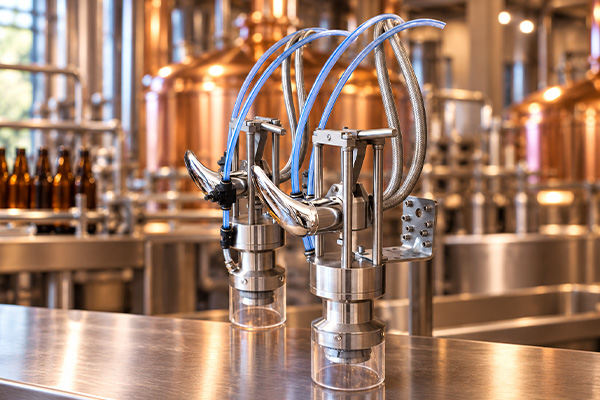
The FENIX is a manual reverse-pressure filling system designed for suitable beverages, particularly carbonated products.
According to Eazy Canning, it operates at up to 4 bar and can fill approximately 3–4 cans per minute per head, with a dual-head configuration capable of approximately 100–150 cans per hour. It is also CIP-compatible and made from food-grade stainless steel.
Counter-pressure filling is particularly relevant for carbonated RTD beverages because controlling pressure during filling can help reduce foaming and preserve carbonation.
The FENIX can be relevant for products such as:
- craft beer
- carbonated beverages
- sparkling tea
- certain RTD drinks
- cold brew and specialty coffee applications
- canned cocktails where the filling process is appropriate
The exact suitability depends on the beverage formulation and production process.
iKAN Can Seamer
After filling, the can needs to be closed securely.
Eazy Canning’s iKAN is a compact manual can-seaming machine designed for small-batch production. It can seam up to approximately 10 cans per minute and accommodates cans across approximately 200–209 mm diameters, with Eazy Canning listing supported volumes of roughly 200 ml to 1,000 ml.
The machine uses food-grade 304 stainless steel and has a compact footprint of approximately 44 × 18 × 35 cm, making it suitable for production environments where space is limited.
For a startup, that flexibility can matter.
The business may begin with one can size and later test another without immediately replacing its seaming equipment.
FENIX + iKAN: A Compact RTD Canning Workflow
For a producer that needs both filling and seaming, FENIX and iKAN can form the core of a compact canning workflow.
The process is:
1. Prepare the beverage
The beverage is produced using the appropriate brewing, mixing, carbonation, filtration, refrigeration, or other product-specific equipment.
2. Fill the cans
FENIX can provide controlled counter-pressure filling for suitable beverages.
3. Place the lid
The can end is positioned on the filled can.
4. Seam the can
The filled can is transferred to iKAN for seaming.
5. Inspect and package
The finished cans can then move through the brand’s labeling, coding, quality-control, packing, and storage process.
Eazy Canning describes FENIX and iKAN as a compact approach for startups that need to bring key stages of packaging in-house.
What Should a New RTD Beverage Brand Consider Before Buying Equipment?
Before purchasing a canning system, answer these questions:
1. What is the beverage?
Carbonated, still, alcoholic, non-alcoholic, coffee, tea, functional, or another formulation?
2. What is the target production volume?
Are you producing samples, hundreds of cans, or thousands of cans per batch?
3. What can size will you use?
Your equipment needs to be compatible with the specific can dimensions and ends you intend to use.
4. Do you already have filling equipment?
If yes, you may only need a can seamer.
5. Do you need counter-pressure filling?
This is particularly important for carbonated beverages.
6. Where will production happen?
Consider available floor and table space, utilities, cleaning requirements, storage, and workflow.
7. How quickly do you expect to scale?
Your equipment should solve today’s production problem without unnecessarily overbuilding the operation.
8. What quality-control process will you use?
Filling and seaming equipment does not by itself determine shelf life or product safety. Product formulation, sanitation, processing, packaging, storage, and applicable regulations all need to be addressed.
Final Takeaway
The growth of ready-to-drink beverages reflects a broader shift in how consumers buy and consume drinks.
Convenience makes RTD products easy to consume. Portability expands consumption occasions. Functional ingredients give products additional value. Premium positioning allows brands to differentiate. And flexible packaging enables beverages traditionally prepared in cafés, bars, restaurants, or homes to become retail products.
For beverage startups, the opportunity is particularly interesting because RTD products can be tested and developed in relatively small batches before production is scaled.
That makes flexible canning equipment an important part of the equation.
Eazy Canning’s FENIX filler and iKAN seamer are designed around small and medium production, giving beverage producers a way to bring key filling and seaming stages in-house. The iKAN can seam up to approximately 10 cans per minute, while the FENIX provides counter-pressure filling for suitable beverages.
For a new RTD brand, the objective is not to build the biggest production line from day one.
It is to create a repeatable, professional packaging process that matches current demand and gives the business room to grow.
As your beverage gains customers, expands into new channels, and generates larger orders, your production strategy can evolve with it.

Leave a Reply