
The Future of Beverage Production: Why Small Brands Are Replacing Industrial Lines
For decades, beverage production followed a simple rule:
If you want to scale, you need a factory.
Large industrial lines dominated everything — from beer and coffee to soft drinks and RTD cocktails. High-volume production, rigid supply chains, and expensive co-packing agreements defined how brands entered the market.
But that model is breaking.
This is not just an equipment upgrade.
It is a structural change in how beverages are made, packaged, and brought to market.
The Micro-Manufacturing Trend: Production Is Moving Out of Factories
The biggest shift in the beverage industry is simple:
Production is becoming decentralized.
Instead of relying on large centralized factories, more businesses are producing closer to where products are made, tested, and consumed.
What micro-manufacturing means
Micro-manufacturing refers to:
- small-batch production
- flexible equipment setups
- in-house packaging capabilities
- rapid product iteration
This model is now used by:
- coffee roasters
- craft breweries
- kombucha brands
- restaurants and bars
- beverage startups
Eazy Canning highlights this shift directly: compact systems allow businesses to turn small spaces into functional production units, reducing dependency on industrial facilities and co-packers.
Why this trend is accelerating
Three forces are driving it:
1. Lower barriers to entry
Small brands no longer need million-dollar lines to launch.
2. Faster product cycles
Markets demand constant innovation — seasonal drinks, limited drops, niche flavors.
3. Consumer preference for local and authentic brands
People increasingly trust small, transparent producers over mass-market giants.
Agile Production Systems: Speed Is Now a Competitive Advantage
Industrial beverage production is powerful — but slow.
New product launches often require:
- long planning cycles
- large minimum order quantities (MOQs)
- outsourced co-packing
- delayed feedback loops
This creates a major disadvantage in today’s fast-moving market.
The agile alternative
Agile production systems allow businesses to:
- produce small batches on demand
- test new products quickly
- adjust recipes in real time
- scale only what works
Eazy Canning’s systems are designed around this principle.
Their FENIX filler enables precise, low-waste filling for small batches, while the iKAN seamer ensures consistent, retail-ready sealing — even in compact setups.
Together, they enable production that behaves more like software development than traditional manufacturing:
Build → Test → Improve → Scale
Decentralized Beverage Brands: The End of the “One Factory Model”
Traditionally, beverage brands were centralized:
- one production facility
- one distribution system
- one supply chain
Now, that structure is changing.
What decentralized production looks like
Instead of one factory, brands operate:
- multiple micro-production hubs
- local canning setups
- distributed product lines
- flexible regional output
This allows brands to:
- reduce logistics costs
- produce closer to demand
- test regional variations
- respond faster to market shifts
Why decentralization wins
1. Resilience
If one site fails, production doesn’t stop.
2. Market proximity
Products are made closer to customers, improving freshness and speed.
3. Brand experimentation
Different locations can test different SKUs simultaneously.
Eazy Canning’s compact machines make this model realistic by allowing production lines to exist in small rooms, kitchens, bars, or micro-facilities, rather than industrial plants.
The Core Bottleneck Industrial Lines Created
Industrial systems are powerful — but rigid.
They struggle with:
1. High minimum order quantities
Many co-packers require thousands to tens of thousands of units per run.
2. Slow iteration cycles
Changing a recipe or packaging format can take weeks or months.
3. High capital requirements
Full-scale production lines require significant investment and maintenance.
4. Limited flexibility
Switching between product types (e.g., carbonated to still beverages) is complex and time-consuming.
Eazy Canning addresses these issues directly by focusing on small-batch, flexible, multi-product systems that reduce dependency on large-scale infrastructure.
How Eazy Canning Enables the Shift to Micro-Scale Production
Eazy Canning is built around a simple idea:
Professional beverage production should not require a factory.
Their ecosystem is designed for small and medium producers who want industrial-grade results in compact spaces.
The FENIX Filler: Precision in Small Batches
The FENIX filler is a manual reverse-pressure filling system designed for:
- carbonated drinks
- cold brew coffee
- kombucha
- RTD cocktails
Key advantages:
- minimal oxygen exposure during filling
- precise liquid control
- reduced product waste
- compatibility with small batch runs
It allows producers to maintain product quality without industrial complexity.
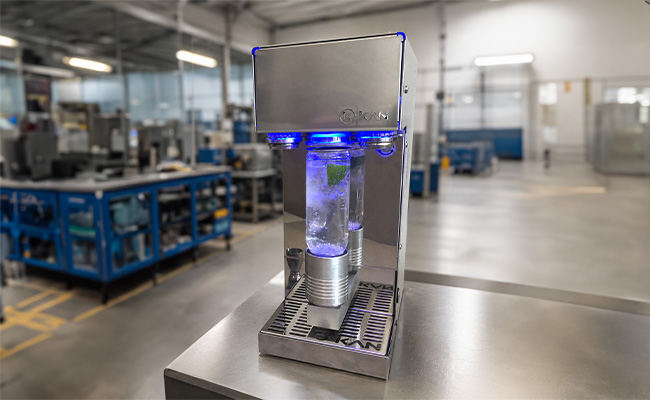
The iKAN Seamer: Retail-Ready Packaging at Small Scale
The iKAN seamer provides airtight sealing for cans across multiple sizes, making products shelf-ready and distribution-safe.
Key advantages:
- consistent seam quality
- compact tabletop design
- supports multiple can formats
- fast output for small teams
It bridges the gap between “homemade product” and “retail-ready brand”.
Together: A complete micro-production line
FENIX + iKAN enables:
- small-space production
- retail packaging capability
- rapid product iteration
- scalable growth without factories
This is what makes micro-manufacturing viable at scale.
6. Why Small Brands Are Replacing Industrial Systems
This shift is not theoretical — it is already happening.
Small brands are winning because they can:
Move faster
They react to trends in days, not months.
Waste less
They produce only what they sell.
Innovate more
Limited runs, seasonal flavors, experimental products.
Stay closer to customers
Direct feedback loops improve product-market fit.
Industry research shows strong growth in small-scale canned beverage production, driven by craft breweries, startups, and specialty drink makers seeking flexible packaging solutions.
7. The Future: Distributed Beverage Ecosystems
The next stage of the industry is not just small brands replacing big ones.
It is something more structural:
A network of distributed micro-brands producing locally, scaling globally.
In this future:
- production is modular
- packaging is flexible
- innovation is constant
- brands evolve faster than factories can keep up
Industrial Beverage Production Is No Longer the Only Path
Micro-manufacturing, agile production systems, and decentralized brand structures are reshaping the beverage industry from the ground up.
And compact technologies like Eazy Canning’s FENIX and iKAN systems are not just tools — they are enablers of this shift.
They allow businesses to:
- start small
- move fast
- reduce waste
- control production
- and scale without industrial dependence
